State the decision you want help with
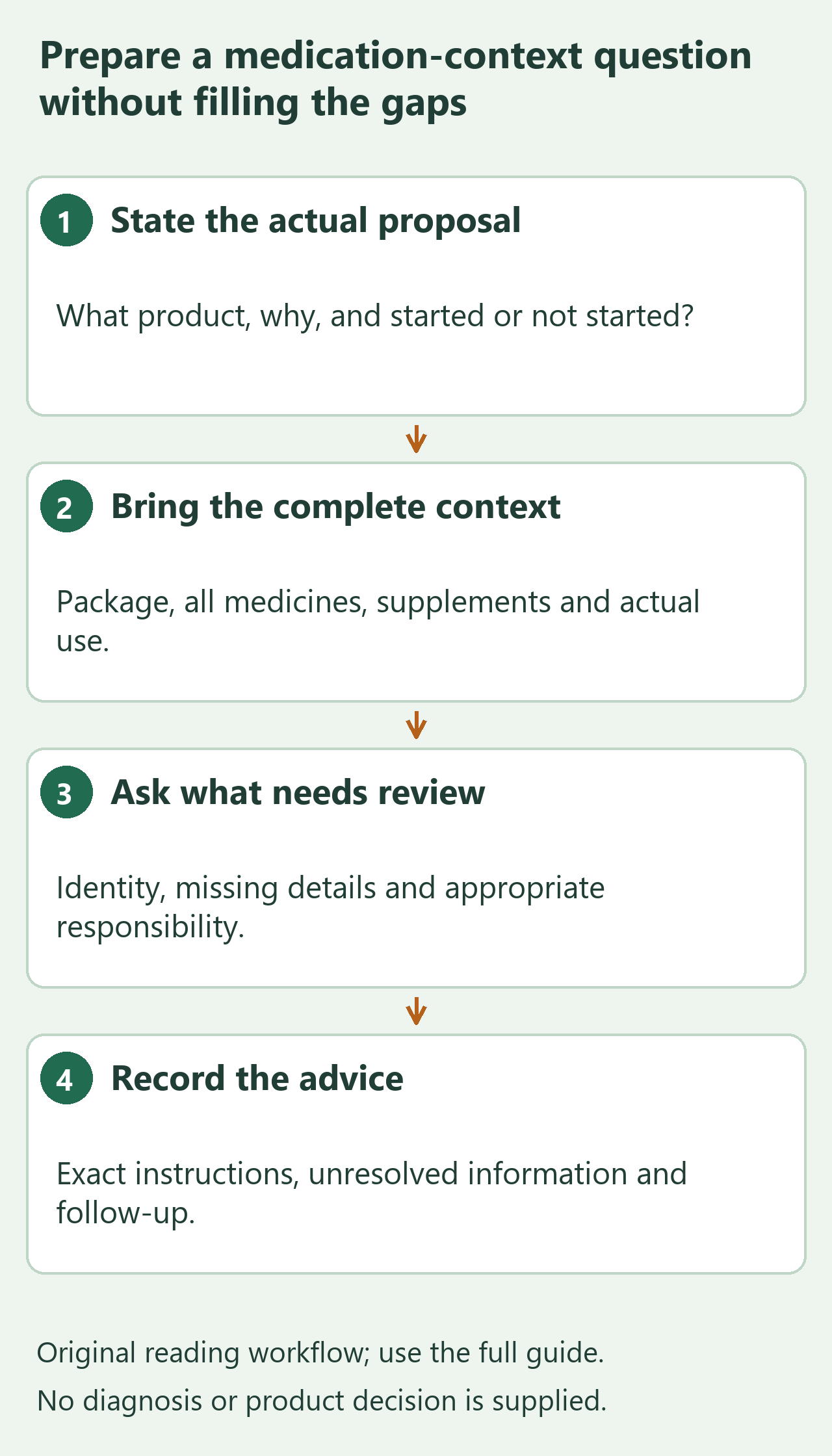
Begin with a specific question: “I am considering this exact product for this reason. What needs checking with the medicines and other products I use?” If you already use it, say so and describe the actual use. A planned use and a past use are different records.
Do not start with a vague statement such as “Is warming food safe?” The word warming does not identify a package, ingredient, preparation or exposure. It can explain why you became interested, but the person reviewing your question needs the actual material and relevant care information.
Prepare the essentials without inventing missing details
On a narrow screen, scroll this table sideways to read all columns.
| Bring | Record accurately | Avoid substituting |
|---|---|---|
| The exact product | Container or readable label, ingredients, form and printed quantities. | A retailer's short description or guessed translation. |
| The complete medicine and supplement list | Prescription and over-the-counter products, supplements, frequency and amounts used. | A prescription-only list or an assumed daily schedule. |
| Actual use or planned use | Not started, currently used or stopped; details known and unknown. | Printed serving directions presented as what actually happened. |
| Relevant care context | The concern, remembered timing and circumstances for professional review. | A constitution label offered as an established cause. |
NCCIH recommends telling all healthcare providers about all medications and dietary supplements, updating the list at visits and bringing bottles when helpful. It specifically advises people receiving cancer or HIV treatment to discuss all supplements with their providers.
The three-card pharmacist record has the detailed product, actual-use and follow-up fields. This page helps frame the medication question; it does not repeat the complete product inventory or perform its assessment.
Ask three focused questions
- Identity: “Do you have enough information to identify this exact product and preparation? What is still missing?”
- Care context: “Which medicines, other products or personal circumstances need review for this proposal? Who should assess an unresolved part?”
- Next step: “What do you advise, what should I record, and when or how should I follow up?”
A clear answer may still leave a missing ingredient or another review unresolved. Keep that gap visible. Do not turn “we need more information” into permission, or interpret lack of a listed interaction in a short article as an individual clearance.
Keep a source claim separate from a medicine decision
A traditional source may classify a food as warm or neutral; that describes its framework. A questionnaire may assign a category or this site's sorter may suggest reading links; that describes its method. Neither checks the actual package against your medicine use.
A study also has a specific preparation, population and outcome. If a seller cites a study of another form, note the mismatch and ask what evidence is relevant to the actual proposal. The food-claim worksheet helps read that source; it does not substitute for the care discussion.
Record the advice and who owns the follow-up
After the conversation, write the professional's instructions accurately, the information still needed and who will review it. Ask if something is unclear rather than constructing a timing or dose change from this website. Do not change a prescribed regimen on the basis of a category, quiz or article.
Keep an earlier discussion attached to the exact product and medicine list reviewed then. If the formulation, products or care circumstances change, present the changed information rather than treating a familiar brand as permanent approval.
A reaction or urgent concern is a separate care question
If you noticed a change after using a product, record what happened and the timing you remember. Timing can help an appropriate professional; it does not establish a cause by itself. For an urgent health concern, seek appropriate local care instead of waiting for a completed checklist or scheduled product conversation.
NCCIH advises against using TCM to replace or delay conventional care and recommends professional discussion before herbal-product use in relevant health circumstances, pregnancy, nursing or for a child. This page cannot diagnose a reaction, assess urgency or decide whether a combination is safe.
Prepare a medication-context question without filling the gaps
Examples to work through
These fictional examples practice reading and keeping information accurate.
No prescriptions does not mean no other products
A fictional reader uses occasional over-the-counter remedies and supplements but no prescriptions. Include those products and actual frequency; a prescription-only list would leave the discussion incomplete.
The product has not been started
A reader is considering a package but has not used it. Write not started and bring the actual information. Do not fill in a fictional daily use or treat printed directions as a personal recommendation.
A category is offered instead of an ingredient
Someone asks about a “neutral tonic” without a readable label. Keep the traditional description separate and identify what product information is missing. The category is not an interaction check.
An old discussion is transferred to a new bottle
A different preparation now shares the familiar brand name, and the medicine list has changed. Bring the differences for appropriate review. Keep the earlier advice with its original context.
A focused medication-context conversation note
Use these optional reminders for your own notes. The blank download contains all record fields. Keep a completed copy appropriately private; these controls do not submit entries.
Frequently asked questions
Should I include over-the-counter products and supplements?
Yes. NCCIH recommends a complete medication and supplement list, including how often and in what amounts they are taken.
What if the ingredient panel is missing or unreadable?
Preserve that uncertainty and bring the package or readable original information when possible. Do not guess the contents from a common name or traditional category.
Can this page check a drug–herb interaction?
No. It prepares the question and relevant information. An appropriate professional needs the exact products and care context to assess it.
Does a previous product discussion apply forever?
Keep it attached to the product, medicines and circumstances reviewed. Present relevant changes and ask what needs an updated review.
Sources and what they support
- NCCIH: Talk With Your Health Care Providers
Complete medicine and supplement lists, actual frequency and doses, product bottles, updates and coordinated discussion; this website does not perform an interaction assessment.
- NCCIH: Traditional Chinese Medicine—What You Need To Know
Dated April 2019 background on different practices, product risks, coordinated care and avoiding replacement or delay of conventional care; not a current review of every food or product.
These sources support the stated explanations and reading limits. They do not establish a clinical review of this website, validate its fourteen-question sorter, or assess an individual product, symptom or treatment.