Practical guide
Reading Chinese Herbal Product Labels: Chinese, Common and Latin Names
Preserve the original label, separate common names from botanical and materia-medica names, and keep plant parts and preparations attached. Use official licorice and Huang Qi examples, an ingredient record and eight cases to document a name match without guessing missing product information.
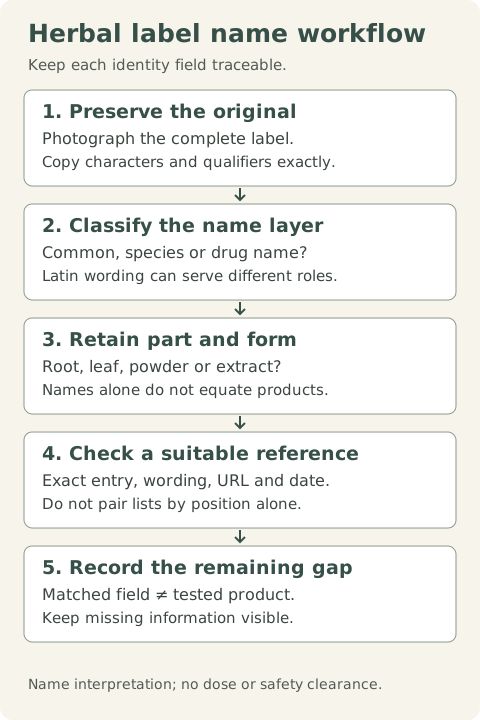
Keep the original label before translating anything
Begin with readable photographs of the actual package: front, ingredient panel, directions, warnings and any product-version or batch information. Preserve the Chinese characters exactly as printed, alongside the English wording. An online shop’s shortened name can omit a species, plant part, preparation or ingredient. Keep the package and the listing as separate sources.
Make one record for each listed ingredient. Copy the original name first, then add any romanization, English common name, Latin wording, plant part and preparation that the label actually supplies. Mark absent or unreadable information as missing. A complete-looking translation made from guesses is harder to check than an honest gap beside a clear photograph.
This guide helps you classify and compare printed information. It does not identify an unknown loose herb, authenticate a package, test its contents or choose a treatment. The original worksheet keeps the name layers separate so you can ask a specific identification question when something remains unclear.
Include every ingredient in a formula, even when the front highlights only one familiar herb. The formula’s product name, an ingredient’s common name and a plant’s scientific name can appear together while referring to different things. Start from the actual ingredient panel rather than using the front name as a substitute for the full composition.
Separate Chinese, common and two kinds of Latin names
The NIH Office of Dietary Supplements explains that a botanical species name combines a genus with a specific epithet. Its example is Actaea racemosa L., black cohosh. “L.” is an author abbreviation referring to Linnaeus in that example; it is not a plant part, serving amount or additional ingredient. ODS notes that its consumer fact sheets omit such initials because most consumer labels omit them.
| Layer | What to copy | What remains to check |
|---|---|---|
| Chinese printed name | Original characters, including any preparation qualifiers. | Whether the exact name identifies the material in this product. |
| Romanized name | The spelling printed on the label, such as a pinyin-style name. | Original characters and the source connecting the spelling to the ingredient. |
| English common name | The exact common wording and any qualifiers. | Whether the source covers one species or several. |
| Botanical scientific name | Genus and specific epithet, plus any printed author information. | Species, plant part and preparation in the actual ingredient. |
| Latin materia-medica name | The complete pharmacopoeial or drug-name wording. | Its monograph and stated source material; it is not automatically a plant binomial. |
The last two rows matter. The Hong Kong Chinese Materia Medica Standards catalog uses names such as Radix Astragali and Radix et Rhizoma Glycyrrhizae. NCCIH’s botanical pages use species names such as Astragalus membranaceus and Glycyrrhiza uralensis. A Latin-looking phrase therefore needs classification before you put it in the “species” field.
Retain the full materia-medica name and the identified monograph when one is supplied. A catalog heading helps you locate a reference; it does not establish that your package contains a material meeting that standard. The standards catalog is also not a dictionary that turns every abbreviated seller name into one confirmed species.
Read the licorice and Huang Qi examples carefully
Use official examples to understand the layers rather than to identify your own bottle by resemblance. The CMRO Chinese catalog includes 甘草 in volume 2 and 黃芪 in volume 1; its English catalog provides the corresponding materia-medica terminology. The NCCIH pages provide common and botanical names for their educational entries.
| Reference topic | Chinese / common wording | Latin wording and its role |
|---|---|---|
| Licorice / 甘草 | CMRO: 甘草. NCCIH common names include licorice, liquorice and gan cao. | CMRO materia-medica name: Radix et Rhizoma Glycyrrhizae. NCCIH lists Glycyrrhiza glabra, G. uralensis and G. inflata as botanical names. |
| Huang Qi / 黃芪 | CMRO: 黃芪. NCCIH common names include Huang Qi and milk vetch. | CMRO materia-medica name: Radix Astragali. The checked NCCIH page lists Astragalus membranaceus. |
The licorice example shows why a common name does not necessarily select one species. NCCIH lists three botanical names on its licorice page. If your package says only “licorice root,” keep the species field missing until the exact product information resolves it. Do not select the first species in a reference and enter it as though it came from your label.
Similarly, the single name listed on the checked NCCIH astragalus page is information about that page, not a proof that every product called Huang Qi has been identified. Keep the product’s own scientific name and source documentation. If another reference gives a different name, ask whether it describes a documented synonym, a different source species or a different material.
Preserve the characters you see. Do not silently replace a traditional-character label with a remembered simplified spelling or a phonetic guess. A verified transcription or translation can be added alongside the original, with its source. That allows another reader to see what was actually printed and what was supplied later.
Keep plant parts and preparations beside the name
A species name identifies a plant taxon; the ingredient record also needs the part and preparation. Copy root, leaf, rhizome or another stated part separately. If the label provides only a Latin materia-medica name, preserve it and look for the actual source and plant-part definition in the appropriate reference. Do not fill missing fields by assuming that the most familiar part is always used.
ODS describes botanical products sold as fresh or dried material, powders, teas, tinctures and extracts. These forms can have different strengths and constituents. The same botanical name on a leaf tea, a root powder and an extract does not make the products interchangeable.
Copy the printed extract wording, solvent or ratio when provided. Keep its units and basis intact. A ratio without a clear definition does not supply a conversion to cups of tea, capsules or a personal dose. Any numerical amount in the label belongs in the record exactly as stated, with “per serving” or another stated basis attached.
For a multi-ingredient formula, keep the blend total separate from any individual ingredient amounts. An unspecified individual quantity stays unspecified. If “other ingredients” are listed, retain those too. The pharmacist-visit checklist provides the separate actual-use and medicine-list record; this article focuses on interpreting the ingredient identity fields.
Match one ingredient to one suitable reference
Start with the complete printed ingredient wording and the context: product category, language, species if stated, plant part and preparation. Open a reference that addresses that material. Record its title, URL, access date and the exact wording supporting a proposed match. Keep an interpretation separate from the copied label line.
| Step | Record | Question left open |
|---|---|---|
| 1. Preserve | Original characters and complete label line. | Is any part unreadable or missing? |
| 2. Classify | Common name, romanization, botanical name or materia-medica name. | Am I putting a drug name in a species field? |
| 3. Compare | Exact reference wording, reference title and URL. | Does it describe this material and preparation? |
| 4. Retain qualifiers | Plant part, processing and extract description. | Has a qualifier been omitted in the listing? |
| 5. Resolve a mismatch | Both names and the source explaining their relationship. | Synonym, different species or unresolved identity? |
| 6. Keep the outcome bounded | What was matched and what remains unconfirmed. | What product information must a qualified person check? |
Search-engine snippets and automated translations can help locate a source, but retain the underlying document as the evidence for a match. A translator may supply plausible wording while leaving the botanical identity unresolved. Preserve the original text so a person with appropriate expertise can review it.
Use the edition and jurisdiction that fit the referenced material. Different naming systems and editions can present names differently. A spelling difference does not automatically mean a different plant, but similar spelling does not establish a synonym either. Keep both terms until a suitable source explains the relationship.
Be careful with parallel language lists. The checked CMRO catalog pages have different ordering within volume 11. Pairing every English and Chinese row solely by its position would produce mistakes. Locate the material’s actual entry or an explicit documented correspondence; do not build a translation table by zipping two lists mechanically.
Use the ingredient identity record and preserve uncertainty
Download the ingredient identity record. It includes a package record and repeatable ingredient rows for original text, name type, species, part, preparation, printed quantity and the evidence supporting a proposed match. Duplicate rows for a longer formula.
Use short outcomes that describe the work actually completed: “printed name copied,” “reference located,” “species still missing,” or “two names require a documented match.” A tick beside a translated name should not turn the entire product into “verified.” Name interpretation is only one part of understanding the package.
For example, you can record that a label prints Glycyrrhiza uralensis and that its name resembles a species listed by NCCIH, while still leaving the plant part or extract definition unresolved. That does not test the bottle’s actual contents or show that a particular use is suitable.
Keep your original photographs and the completed record together. A changed ingredient panel, preparation, manufacturer version or new package requires checking the information that changed. A useful record is traceable to the actual package and exact reference, rather than a reusable identity claim based only on a brand name.
Check eight common label-reading mistakes
These original reading cases test record accuracy. They are not real product assessments, dose recommendations or an identification guide for loose herbs. Open each answer after deciding what the printed information actually establishes.
Case 1
A label says only “licorice root.” NCCIH lists three botanical names for licorice. Can you select the first one as the package species?
Show answer and explanation for case 1
No. Record the common name and leave the package species missing.
The reference shows why the common name is not a unique species selection. Obtain the exact product information rather than replacing a missing field with a familiar name.
Case 2
A label prints “Radix Astragali.” Does that text belong automatically in a botanical-species field?
Show answer and explanation for case 2
Keep it as the printed Latin materia-medica name.
The CMRO catalog uses that name for its materia-medica entry. A plant binomial such as Astragalus membranaceus is a different name layer; retain the relevant source and material definition.
Case 3
A botanical label includes “Actaea racemosa L.” Is “L.” another ingredient or a quantity?
Show answer and explanation for case 3
No. In the ODS example it is the author abbreviation for Linnaeus.
Genus and specific epithet form the species name. Retain printed author information without mistaking it for a plant part or serving unit.
Case 4
A seller translates a Chinese label but the original characters are unreadable in its image. Is the original-name field complete?
Show answer and explanation for case 4
No. Preserve the seller wording separately and mark the original text unreadable.
A plausible translation is not a transcription of a label you can read. Obtain a readable original before treating that field as confirmed.
Case 5
Two products share a botanical name, but one says root powder and the other says extract. Can you substitute one record for the other?
Show answer and explanation for case 5
No. Keep their plant-part and preparation details separately.
ODS explains that botanical forms can differ in strength and constituents. A shared name does not supply equivalent amounts, effects or personal-use instructions.
Case 6
A formula lists three botanical ingredients and one blend total without separate quantities. Can you divide the total equally among the ingredients?
Show answer and explanation for case 6
No. Preserve the blend total and mark the individual amounts unspecified.
An equal division would invent composition. The name record keeps the stated quantities and their basis without creating doses.
Case 7
English and Chinese catalog lists contain the same volume headings. Can a script translate them by pairing every row in order?
Show answer and explanation for case 7
Do not rely on row order alone; verify the actual entry or documented correspondence.
The checked CMRO volume 11 ordering differs across the two language pages. A mechanically completed table can look precise while matching the wrong names.
Case 8
You have resolved a name match. Does that verify the bottle’s contents or suitability with a medicine?
Show answer and explanation for case 8
No. Record the name match and retain the separate product-quality and clinical questions.
ODS says quality is difficult to determine from a label, and quality seals do not establish safety or effectiveness. The appropriate professional needs the exact product and relevant care context.
Use the name record for the next appropriate question
A readable name record helps a pharmacist or another appropriately qualified professional understand the product you mean. It cannot establish purity, contamination status, effectiveness or individual suitability. ODS notes that quality is difficult to determine from the label and that quality-assurance seals do not guarantee a product is safe or effective.
Keep ingredient risks separate from naming. NCCIH’s licorice fact sheet describes potentially serious effects from glycyrrhizin and reported interactions with corticosteroids, and advises people taking medicines to discuss herbal products with their health care provider. Correctly spelling a licorice species does not resolve those clinical questions. Its astragalus page also describes evidence and safety uncertainties; its name list is not a recommendation to use the product.
Bring the actual package and use the pharmacist-visit record for the separate medicine list, use history and advice. For claims about a preparation, use the TCM claim-evidence worksheet to see whether the evidence addresses the same material and question. Leave with an accurate record of known and missing information, rather than a stronger conclusion than your sources support.
Sources and further reading
- NIH ODS: Botanical Dietary Supplements — Background InformationGenus and specific epithet, the Actaea racemosa L. example, product forms and limits of label-based quality judgments.
- NCCIH: Licorice Root (April 2025)Exact common-name and three-species lists; product-form and safety questions remain distinct from naming. No recommended dose inferred.
- NCCIH: Astragalus (May 2025)Huang Qi and other common names, the botanical name actually shown, and evidence/safety uncertainty; not an exhaustive taxonomic authority.
- Hong Kong CMRO: HKCMMS Materia Medica List — EnglishActual Latin materia-medica names and catalog organization; catalog inclusion does not authenticate a consumer product.
- Hong Kong CMRO: HKCMMS Materia Medica List — Traditional ChineseOriginal 甘草 and 黃芪 characters and Chinese catalog organization; volume 11 ordering differs, so no blanket positional translation is inferred.