Practical guide
Herbal Product Discussion Checklist for a Pharmacist Visit
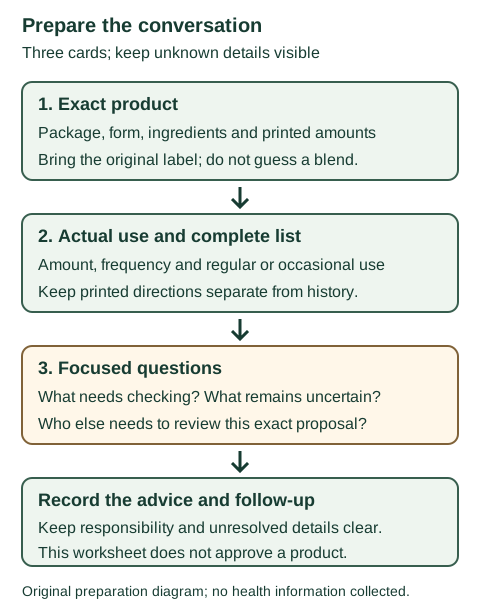
Bring the original product information, a complete list of actual medicine and supplement use, and focused questions. Three editable cards keep printed amounts, use history and unknown details separate, then record the professional advice and follow-up.
Bring the product, actual-use list and one clear question
Before a pharmacist visit about an herbal product, prepare three things: the exact package or readable label, a current list of everything you actually take, and the question you want answered. Keep printed directions separate from your real use. An unknown ingredient or amount belongs on the list as unknown.
NCCIH advises telling all health care providers about all medicines and dietary supplements, updating that information at visits, and bringing a written list with frequency and doses. It also suggests bringing the product bottles so a provider can answer ingredient questions.
This checklist turns that preparation into three editable cards. You can use a paper copy or your own private file; there is no form here asking you to send medical details. It does not check interactions, choose a product or decide a dose. The pharmacist needs the actual product and your relevant care context to assess the question.
If you have not started the product, write “not started” instead of filling in an imagined daily routine. If you already use it, describe that honestly. A record of use is information for the conversation, not an endorsement of the amount or a reason to change prescribed treatment yourself.
Card 1: identify the exact product and missing information
Bring the original container when practical. If that is difficult, take readable photographs of the front, ingredients, directions and warnings. A photo of the brand name alone often leaves the important details out. Include the original-language label rather than replacing it with a guessed translation.
NCCIH’s supplement-label guidance points readers to the Supplement Facts panel and other ingredients. Packaging formats differ by country and product category. Copy the information your package actually provides, and mark an absent plant name, amount or preparation detail as missing.
CARD 1 — THE EXACT HERBAL PRODUCT
Product name and manufacturer:
Package / label language:
Form: food, tea, powder, capsule, extract or other:
Ingredients copied exactly; include other ingredients:
Plant names / plant parts if stated:
Printed serving amount and unit:
Amount listed per serving:
Blend total / individual amounts not provided:
Directions and warnings copied from the package:
Batch or lot / expiry if available:
Original package or clear label photos available:
Purpose I am considering it for:
Status: not started / currently used / stopped:
Missing or unreadable information:
Do not reduce a multi-ingredient formula to its most familiar herb. Keep every listed ingredient, including capsule materials or other ingredients relevant to an allergy question. Write the plant part and extract description when given. A leaf tea, root powder and concentrated extract with similar names are different products to identify, not automatically interchangeable exposures.
| Detail | Useful record | Avoid substituting |
|---|---|---|
| Name and manufacturer | The exact label, including product version. | A generic nickname such as “my balance herb.” |
| Form | Tea, food ingredient, powder, capsule or stated extract. | Assuming all forms match the same research. |
| Ingredients | Copy all stated names and other ingredients. | Guessing a species from a translated common name. |
| Serving and quantity | Keep the number, unit and per-serving basis. | Calling a blend total an amount for every herb. |
| Directions and warnings | Bring the actual printed wording. | A retailer’s summary instead of your package. |
| Actual identity gaps | Mark an unreadable or missing detail. | Treating the blank as proof of absence. |
| Package version | Lot, expiry and package photographs if available. | Assuming a similarly named bottle is identical. |
A third-party quality mark can address defined quality checks. It does not by itself show that the product benefits your condition, fits your medicines or has an appropriate dose for you. Bring the mark and its stated scope as information, rather than writing “safe” on the card.
Card 2: record actual use alongside all medicines and supplements
Make one row or repeated card for each prescription medicine, over-the-counter medicine and supplement. Include occasional products as well as daily ones. “I do not take prescription medicines” is not the same as “I take nothing else”; pain remedies, cold products, vitamins and other herbal products may still matter to the discussion.
CARD 2 — WHAT I ACTUALLY USE
Prepared date:
For EACH prescription, over-the-counter medicine and supplement:
Exact name and formulation:
Label / prescribed strength and unit:
Actual amount per occasion:
How often; regular or occasional:
Usual timing and most recent use if relevant:
Start / stop date if known:
Differences from the printed directions:
Unknown details to check:
Other herbal products, vitamins or relevant drinks:
Allergies and previous reactions to discuss:
Health conditions / pregnancy / nursing / child context:
Planned procedure and date if relevant:
Changes or symptoms and their timing:
Write quantities in the form you actually use: capsules per occasion, measured liquid and unit, or another stated amount. Retain the product strength separately. “One tablet” alone may not identify the formulation; “500 mg” alone may not describe how many tablets you take. If you cannot read or remember a detail, bring the container and write “to check.”
Keep frequency honest too. “Occasionally, date uncertain” is more useful than a made-up daily schedule. If use differs from the directions or prescribed instructions, record that difference for the pharmacist. Do not edit the history to make it look correct, or use this checklist to correct the regimen yourself.
Bring relevant allergies, previous reactions, health conditions and care plans to the conversation. NCCIH especially advises professional discussion before TCM herbal use during pregnancy or nursing, or when considering it for a child. Its guidance also says not to replace or delay conventional care with TCM. An online constitution label does not supply that clinical context.
If something changed after starting a product, note what changed, when use began and the timing you remember. Timing is useful information, but it does not establish a cause by itself. For an urgent health concern, seek appropriate local care rather than waiting for a scheduled product discussion.
Two fictional examples: a printed serving is not the use history
These examples are invented solely to show how to complete a record. Their numbers are not recommended doses, tested products or examples of a safe regimen.
Example A: a blend with incomplete ingredient amounts
An imaginary “Example Botanic Blend” package states “serving: 2 capsules” and “botanical blend: 600 mg,” with three named ingredients but no separate quantities. The person reports taking one capsule once yesterday.
Record the printed two-capsule serving and 600 mg blend total together. Then record “one capsule once yesterday” in actual use. The printed total does not reveal each ingredient’s amount. Do not divide 600 mg equally between three herbs, treat 600 mg as the amount of each herb, or silently write a two-capsule daily history.
Example B: an occasional tea with an unreadable packet
A second fictional person says, “I sometimes drink a tea sold as a warming blend.” Its ingredient panel is unreadable and the person cannot recall the amount of leaf used. Record the product description, occasional use, the missing details and any available package photo. Do not translate a traditional warming description into an ingredient list or a measured exposure.
A useful question is: “Can you identify this product from the package, and what further information is needed before discussing it with my medicines?” Neither example earns an interaction clearance from its arithmetic or from the absence of a reported reaction.
Card 3: ask about interactions without turning a list into clearance
Ask a focused question about the exact product and complete use list: “What needs checking before I consider this with the medicines and other products listed here?” You can also ask what is known, what remains uncertain, and whether another member of your care team needs to review it.
CARD 3 — QUESTIONS AND THE AGREED NEXT STEP
Main question and purpose:
Can you identify this exact product and its ingredients?
Which of my medicines or other products need checking?
What evidence is known, uncertain or not applicable?
Does my health context change the assessment?
Who needs to review an unresolved question?
Advice given; record the professional's exact instructions:
Any monitoring or follow-up they recommend:
Person / team responsible:
When and how to follow up:
What remains unresolved:
Who else in my care team needs this updated list:
NCCIH’s December 2024 professional digest on herb–drug interactions explains that many proposed interactions rely on indirect evidence and that well-designed clinical studies are limited or sometimes inconclusive. It also describes documented or potentially important interactions. The right conclusion is not that every proposed pair is proven harmful, or that uncertainty means an interaction cannot occur.
| Reported example | What NCCIH says | Question to retain |
|---|---|---|
| Ginkgo with warfarin | The combination is associated with increased risk of major bleeding events compared with warfarin alone. | Bring the exact products and care context for professional assessment; do not invent a dose adjustment. |
| Asian ginseng with warfarin | Studies of the effect have had mixed results. | Ask how the uncertainty affects the review of this particular product and medication. |
| High-dose green tea with nadolol | High doses have reduced blood levels and therefore effectiveness of nadolol. | Identify the actual form and amount; do not assume the evidence clears or condemns every ordinary cup of tea. |
This short table is an attributed illustration, not a complete interaction database. A herb or medicine absent from it has not been checked. NCCIH identifies particular concerns for drugs with a narrow therapeutic index and advises people receiving cancer or HIV treatment to discuss all supplements with their care providers.
Do not propose a universal “take them two hours apart” solution. The cited digest describes different interaction mechanisms; the clock alone does not establish that a combination is suitable. Ask for product-specific instructions where appropriate, and record the professional’s exact advice rather than constructing timing or dose rules from this article.
Keep the agreed next step and unresolved information
At the end of the conversation, check that you understand what the pharmacist has advised, whether another professional needs to be involved, and how to follow up. Write those details on Card 3. If an ingredient still cannot be identified, keep that uncertainty visible rather than describing the whole product as reviewed.
Ask whether changes to your product or medication list require another review. A different extract, formulation, medicine or health circumstance can change the question. An earlier conversation about one bottle is not a permanent clearance for every product sharing its brand or common herb name.
A TCM food category or constitution questionnaire result may explain why you were interested in a product. It does not choose the product or settle the interaction question. The questionnaire interpretation guide separates score meaning from diagnosis, and the food-claim evidence worksheet explains why culinary ingredients and studied extracts need different evidence.
NCCIH’s TCM overview, updated April 2019, discusses mixed findings and quality problems in Chinese herbal-product research, along with contamination and manufacturing errors reported for some products. This is dated background, not a review of your package. A readable label helps the discussion but does not test the contents or demonstrate a health benefit.
Download a private copy of the three-card visit record
Download the editable herbal-product pharmacist visit record. It includes all three blank cards, both fictional examples, the attributed evidence comparison and six explained cases. Print it or edit a local copy, then bring only the relevant information to your health professional.
You can leave unavailable fields marked “unknown” and use them as questions. A short accurate list with the original package is more useful than a complete-looking list built from guesses. Update it when you discover a missed product or a detail changes.
The record contains personal health information once you fill it in. Keep your completed copy private and share it directly with the appropriate care team. This website provides the blank file; it does not receive, store or review your completed answers.
Six checks before relying on a completed record
These original cases test the accuracy of visit preparation. They do not assess your health or determine whether a combination is suitable.
Case 1
A package states a two-capsule serving, but you took one capsule once yesterday. Which number belongs in actual use?
Show answer and explanation for case 1
One capsule once yesterday; retain the printed two-capsule serving separately.
The package statement and your history answer different questions. Recording what happened does not endorse that amount. Give the pharmacist both details rather than replacing the history with a label-directed daily schedule.
Case 2
A fictional three-herb blend states 600 mg total but no separate ingredient amounts. Can you record 200 mg of each herb?
Show answer and explanation for case 2
No. Keep the 600 mg total and mark individual amounts as not provided.
An equal division is an invented composition. The label does not show how that total is distributed or identify an appropriate dose. Bring the complete package and ask what further information is needed.
Case 3
You take no prescription medicines but occasionally use cold remedies and another supplement. Should the list say “nothing else”?
Show answer and explanation for case 3
No. Include the occasional over-the-counter products and supplement.
NCCIH advises a complete medicine and supplement list with amount and frequency. Record occasional use honestly and bring containers when details are uncertain; prescription-only status is not a complete history.
Case 4
Your tea packet has an unreadable ingredient panel and a warming description. Does the traditional category identify its ingredients?
Show answer and explanation for case 4
No. Keep the category separate and record the missing product details.
A traditional description does not supply a species, preparation or amount. Preserve the packet or a readable original-language source for identification, rather than guessing an ingredient list from the category.
Case 5
The three-example table does not mention your herb. Does absence mean that it is suitable with your medicines?
Show answer and explanation for case 5
No. The table is an illustration, not an exhaustive interaction assessment.
Bring the exact product and complete list for professional review. NCCIH describes both documented interactions and uncertainty; absence from a short article provides no individual clearance or timing solution.
Case 6
A pharmacist previously discussed one extract. You now have another formulation and a changed medication list. Can you carry the earlier conclusion over unchanged?
Show answer and explanation for case 6
Do not assume it applies unchanged; present the new details for review.
The exact product and care context are part of the question. Retain the previous advice accurately, identify what changed, and ask about an appropriate updated assessment and follow-up instead of treating the brand name as permanent approval.
Sources and further reading
- NCCIH: Talk With Your Health Care ProvidersComplete medicine/supplement lists, frequency and doses, product bottles, coordinated discussion and cancer/HIV treatment context.
- NCCIH Clinical Digest: Herb–Drug Interactions (December 2024)Limited or inconclusive clinical evidence, narrow-therapeutic-index concerns and specifically attributed ginkgo, ginseng and high-dose green-tea examples.
- NCCIH: Traditional Chinese Medicine—What You Need To Know (April 2019)Dated TCM evidence and product-quality background; coordinated care, pregnancy/nursing/child context and avoiding replacement or delay of conventional care.
- NCCIH: Tips on Reading Supplement LabelsFind the actual ingredients and Supplement Facts/other-ingredient information; quality testing is kept separate from individual suitability and benefit.