Three sentences can carry very different claims
On a narrow screen, scroll this table sideways to read all columns.
| Sentence type | Fictional example | What would support it? |
|---|---|---|
| Reported experience | “I felt tired after these activities on these dates.” | The person's account, with timing and context kept accurate. |
| Traditional interpretation | “An online sorter suggested reading about Qi deficiency.” | The tool's actual output and method; not a diagnosis from this site. |
| Causal conclusion | “That constitution caused my tiredness.” | Additional appropriate assessment and evidence; neither earlier sentence establishes it. |
The observation can be useful even if the interpretation is uncertain. Do not replace the first sentence with the second when preparing a care conversation. A person receiving the note needs to know what happened, not only the label you found online.
Why one familiar sign cannot settle a constitution or cause
Constitution questionnaires group responses within a named traditional framework. The 2013 CCMQ study allowed more than one imbalanced category and discussed uncertainty around their overlap. It also distinguished scale-score reliability from category reproducibility. Those findings do not support treating one experience as a unique signature for one category.
This site's fourteen-question tool is simpler still: it uses fixed editorial weights to order reading links. “Qi deficiency appeared first” records a website ranking, not a physiological explanation. The questionnaire reading guide explains why an instrument's name, questions and research need to match.
Rewrite a note without adding a diagnosis
Start with the exact experience and its time course. If useful, add the source of any traditional wording in a separate sentence. Keep details unknown when you do not remember them. The examples below are invented wording exercises, not patient histories or advice about the symptoms named.
- Instead of: “My cold hands prove Yang deficiency.” Write: “I noticed cold hands in this setting on these dates. I also read a page about Yang deficiency; I do not know whether it applies.”
- Instead of: “Dampness explains my heaviness.” Write: “I use heaviness to describe this particular feeling. A traditional article used dampness, but I have not established a cause.”
- Instead of: “My balanced result means nothing is wrong.” Write: “The tool suggested a balanced reading page. I still want to discuss this separate concern.”
If a professional has already used a traditional term, preserve who said it and in which consultation. That is different from attributing the same conclusion to a website or repeating a family phrase as though it were an established clinical finding.
Bring timing and product context without deciding the cause
Useful notes can include what changed, when it began, how often it happens, its effect on daily activities and relevant changes you remember. If you are taking products, keep their exact names and actual use available. NCCIH advises giving healthcare providers a complete picture of medicines, supplements and complementary approaches.
“This started after I began the product” reports a sequence. “The product caused it” adds a causal conclusion. Keep the sequence accurate so an appropriate professional can assess it. The pharmacist visit record holds product and use details separately.
Use the note to ask about the actual concern
An opening question can be: “Here is what I noticed and when. What information do you need to assess it?” You can ask about the meaning of a traditional label too, but the label should not erase the experience or determine that care can wait.
This page cannot diagnose a symptom, assess urgency or provide a safe waiting period. For an urgent concern, seek appropriate local care. NCCIH advises against replacing or delaying conventional care with TCM. You do not need to finish a reading path or produce a perfect record before contacting suitable help.
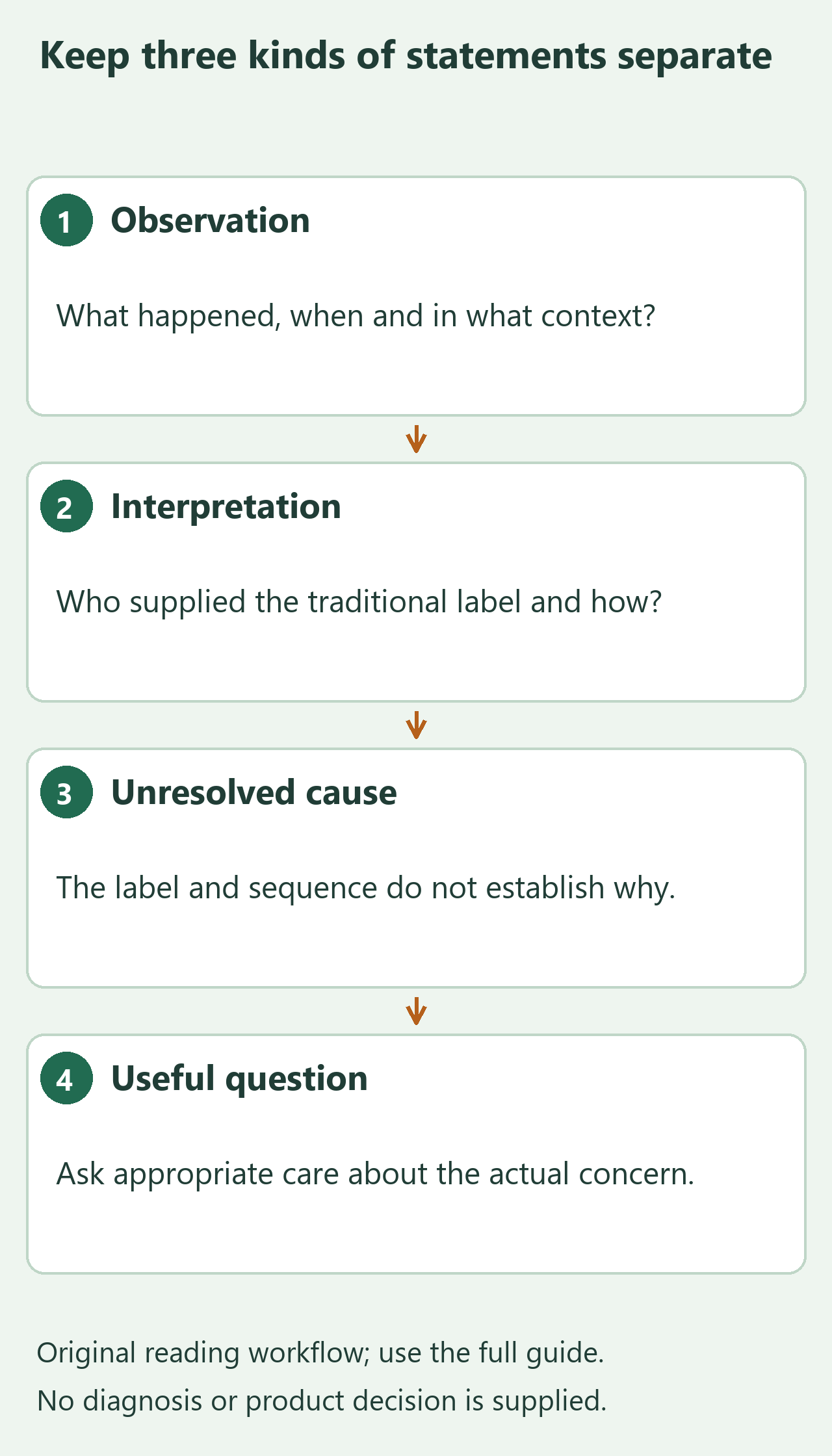
Keep three kinds of statements separate
Examples to work through
These fictional examples practice reading and keeping information accurate.
The interpretation replaces the observation
A fictional note says only “I have dampness.” Its author rewrites it to describe the actual feeling, dates and context, then puts the source of the traditional word in a separate sentence. The result retains information without assigning a cause.
Two labels seem to fit
An online result lists Qi deficiency and Yang deficiency. The reader can compare the names for vocabulary. The overlap does not establish two conditions or settle why a reported experience occurred.
A change follows a product
Someone remembers that a change began after starting an herbal product. They record the sequence and exact package, without calling timing proof of causation or changing a prescribed regimen from this article.
A professional’s phrase is quoted
A reader was given a traditional term during a consultation. They keep the term, the professional who used it and the context beside their ordinary account. They do not attribute that assessment to the website’s quiz.
Observation and interpretation: a private wording note
Use these optional reminders for your own notes. The blank download contains all record fields. Keep a completed copy appropriately private; these controls do not submit entries.
Frequently asked questions
Is a constitution label the same as a symptom?
No. A reported symptom describes an experience; a constitution label applies a traditional classification framework. Neither alone establishes a cause.
Should I omit the label when speaking with a professional?
You can include its exact source separately. Retain the ordinary description and timing so the label does not replace relevant information.
Does an overlapping quiz result confirm two diagnoses?
No. This site’s result orders reading links. Research instruments also have specific overlap and classification rules that do not turn this sorter into a diagnosis.
Can the worksheet tell me whether care can wait?
No. It organizes wording and context. It cannot assess urgency or provide a safe waiting period, and a completed worksheet is not required before seeking help.
Sources and what they support
- Wong et al. (2013): Validation of the Constitution in Chinese Medicine Questionnaire
The introduction, methods, discussion and conclusions were read for this repair: original 60-item scales, Hong Kong adaptation, overlap, score versus classification reproducibility and study limits. Other result tables and cited papers are not claimed independently reviewed here.
- NCCIH: Talk With Your Health Care Providers
Complete medicine and supplement lists, actual frequency and doses, product bottles, updates and coordinated discussion; this website does not perform an interaction assessment.
- NCCIH: Traditional Chinese Medicine—What You Need To Know
Dated April 2019 background on different practices, product risks, coordinated care and avoiding replacement or delay of conventional care; not a current review of every food or product.
These sources support the stated explanations and reading limits. They do not establish a clinical review of this website, validate its fourteen-question sorter, or assess an individual product, symptom or treatment.