Practical guide
Why Tongue Photos Are Unreliable for Self-Assessment
Lighting, exposure, focus, posture and editing affect what a tongue photograph shows. This guide separates image quality, feature recognition, traditional descriptions and clinical assessment, with two comparison tables, an original illustration, a downloadable reading record and six explained cases.
A photograph is a record, not a complete assessment
A tongue photograph can show part of the tongue’s appearance at the moment it was taken. It also records the effects of lighting, camera settings, focus, posture and any subsequent editing. A difference between two photographs therefore has more than one possible explanation. The images alone do not tell you whether your health, a traditional constitution category or a treatment outcome changed.
This guide helps you read those limitations before relying on a home photo or an app result. It provides a capture-comparison table, a plain-language method for checking research claims and six explained examples. It does not ask you to upload a photograph, identify your constitution or interpret a colour as a diagnosis.
In TCM, tongue observation belongs to a traditional system of assessment. A description within that framework is different from an independently established medical diagnosis. A label such as “heat” should not be silently converted into a fever measurement, and a constitution name should not become a prescription from a picture. Keep traditional vocabulary, image observations and clinical decisions as separate questions.
A photo may still be useful when a health professional requests it for a specific purpose. Follow that person’s instructions and provide relevant context through the agreed channel. Improving the record can help the conversation; it does not replace the conversation or the assessment.
Check capture differences before comparing appearance
First ask whether the two images were taken under comparable conditions. Note the device if known, the lighting, whether the image was sharp, the visible area and any editing. If the conditions are unknown, keep them unknown. Do not reconstruct a precise exposure setting or claim that a shared room necessarily had identical light.
A 2022 tongue-image quality study deliberately varied lighting, exposure and tongue protrusion conditions. Its quality criteria included clarity, brightness and darkness, colour distortion and the visible tongue posture. Excessive light could make an image look too white, while dim light or insufficient exposure could darken it. Those are reasons to question a photo comparison, not rules for deciding what a person’s tongue colour means medically.
| Difference | What you may notice | Reasonable recording conclusion | Unsupported conclusion |
|---|---|---|---|
| Lighting or exposure | One image looks paler or darker. | A different capture condition may affect appearance. | A new constitution, a deficiency or recovery. |
| Blur or movement | Fine texture is difficult to see. | The photograph may not preserve the detail. | That the detail is absent on the actual tongue. |
| Posture or framing | The visible surface or outline differs. | Different areas or shapes may be shown. | A measured biological change from the outline alone. |
| Colour or beauty edit | A filter or adjustment was applied. | The displayed image is an edited version. | A clinically calibrated colour or a treatment effect. |
| Missing capture history | The source and conditions are unknown. | The comparison has important missing information. | That two attractive images are medically comparable. |
| A repeated setup | The same phone and setting were used. | Some avoidable differences may be reduced. | That remaining differences establish a diagnosis. |
A crop can also remove the context needed to see which area was photographed. Sharing an enlarged portion does not supply details that were blurred in the original. A colour filter creates an edited version; a more attractive or more vivid image is not automatically a more faithful clinical record.
You do not need to run a home experiment or buy an imaging device to understand these limits. If a photograph has already been requested, ask the receiving professional for their capture instructions. Do not prolong or force an uncomfortable posture to imitate a research image.
See why an image difference has several possible explanations
View the capture-difference illustration. The coloured blocks below are original fictional graphics. They are deliberately not tongue photographs, medical colour standards or a calibration target. Their purpose is to make the reasoning visible: changed brightness, colour rendering or available detail can change what an image shows without establishing a health explanation.
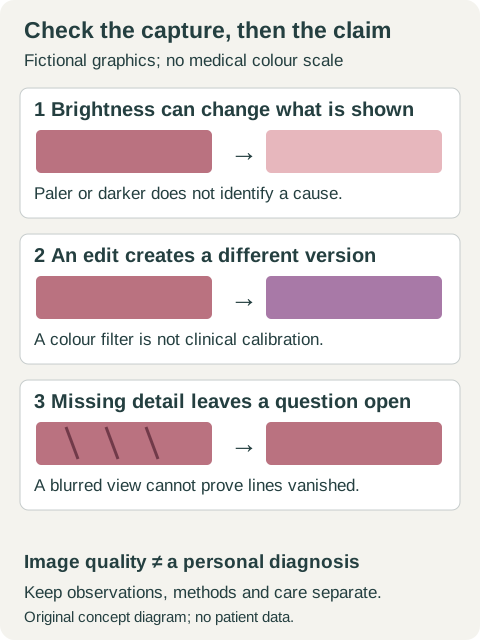
Read the illustration as a comparison problem. A paler block is a different display of a block; it is not evidence of a deficiency. A shifted colour shows that an edit can alter appearance; it does not identify a particular phone’s processing. Missing lines show lost information; they do not prove that a physical feature vanished.
Even when a photo appears clear, the next question remains open: what interpretation is supported for the purpose at hand? A clear image and a well-supported health conclusion require different evidence. Repeated photos cannot fill that gap simply by creating a larger folder.
Ask what an AI accuracy claim actually tested
When a website cites a high accuracy figure, read the name of the task before reading the number. Image-quality assessment, segmentation and classification answer different questions. A result can be strong for a narrow image task without establishing a constitution diagnosis, disease probability or suitable treatment.
| Task | Question tested | Reference to inspect | What it does not automatically establish |
|---|---|---|---|
| Image-quality assessment | Does a photo meet a specified image-quality label? | Who labelled quality and which defects were included? | Personal health or constitution accuracy. |
| Segmentation | Which pixels belong to the tongue region? | How were the reference boundaries annotated? | That the region has been clinically diagnosed. |
| Feature classification | Does the image match a named feature label? | What exact feature and reference labels were tested? | A validated diagnosis of every condition. |
| Health or treatment claim | Does a defined clinical outcome follow? | What independent outcome, population and evaluation support this use? | Evidence borrowed from an unrelated image task. |
For example, the 2022 quality paper compared images with quality labels assessed by three TCM practitioners. That reference concerned whether the images were acceptable under the study’s quality criteria. It was not a test of whether an app correctly diagnosed the health of every photographed person.
The 2026 portable-system study tested tongue-region segmentation and fissured-tongue feature recognition. Its classification dataset used 684 images, with fissured and non-fissured feature labels. Those labels describe the tested visual task; they are not interchangeable with constitution categories or independent disease diagnoses. The paper’s reported performance should stay attached to that task and dataset.
Check the exact output, reference labels, population and acquisition setting. Then ask whether the app you are considering uses the studied method for the same purpose. A paper’s existence does not validate a different website, a different camera workflow or a commercial recommendation placed beside an image result.
Retain the limitations of the two imaging studies
The 2022 quality study used professional acquisition equipment and deliberately changed the shooting conditions to obtain low-quality examples. Three TCM practitioners assessed quality, resolving differing evaluations by consensus. Its authors noted that these varied scenes might not represent every low-quality image encountered in clinical practice, and that independent verification with clinical-practice data was needed.
That is useful evidence that capture quality deserves attention. It is not a universal standard for every home camera or a demonstrated accuracy estimate for your own picture. The study evaluated a post-acquisition quality module; its discussion described real-time acquisition integration as future work.
The 2026 paper proposed a guided imaging terminal with supplementary lighting and automated analysis. Importantly, its study dataset came from smartphones used by clinicians in routine diagnosis and treatment at a TCM hospital. The images were not all collected under the proposed terminal’s tightly controlled conditions. The dataset’s model results therefore should not be described as proof that the terminal eliminates home lighting variation.
The authors separately stated that terminal usability and illumination robustness required further quantitative validation across broader users and environments. They also noted that the analysis focused on fissured-tongue recognition, and that several subject and acquisition factors were not systematically controlled or analysed. Their explicit interpretation was preliminary imaging-feature recognition rather than independent clinical diagnosis.
These are two selected studies, not a systematic review of tongue diagnosis or proof that all such research is worthless. They show how to keep a promising engineering result within its actual scope. A paper may support further research while leaving a personal health question unanswered.
Keep a useful record when a professional requests a photograph
If a professional asks for a photograph, first clarify its purpose and follow their capture and sending instructions. Keep the original version. Record the actual date and any known capture difference, such as a different device or lighting. If a photograph was recalled later or its original conditions are unknown, say so rather than adding guessed technical details.
Describe the concern in ordinary words separately from what the image appears to show. “I am concerned about this change and noticed it on this date” is a different statement from “the image proves damp-heat.” A photo description should not silently become the cause of a symptom. Let the receiving professional decide what additional history, examination or tests are relevant.
Use the photo-interpretation reading record and six explained cases to separate known capture facts, image observations, the claimed output and remaining questions. It is an original reading aid, not a validated assessment or a medical referral form. It requires no photo upload to this website.
If you also have a constitution-quiz result, keep its instrument and scoring definition separate. The questionnaire result-reading guide explains why a score out of 100 is not automatically a disease probability. A photo label and a questionnaire label do not validate one another merely because their wording seems similar.
Choose what to share through an appropriate agreed channel. A publicly posted photo or comment may disclose information you intended only for a care conversation. This worksheet does not require public posting, a paid app or repeated submissions to obtain a preferred result.
Do not let a photo result choose treatment or delay care
A reassuring picture does not clear a person of health concerns, and an alarming app label does not establish a disease. Seek appropriate professional advice about the actual concern rather than waiting for a photograph to look different. This guide cannot assess urgency, supply a safe waiting period or tell you which treatment is needed.
NCCIH’s TCM information advises discussing complementary approaches with healthcare providers and avoiding replacement or delay of conventional care. Its page was last updated in April 2019; it supports that care boundary here, rather than a newly evaluated tongue-photo method. It also describes risks associated with some herbal products. An image or constitution label cannot establish that a particular herb, supplement, restrictive diet or medication change is appropriate.
Traditional food descriptions have their own limits. The warming and cooling foods guide distinguishes serving temperature, traditional categories and nutrition. A tongue photograph should not collapse those distinctions or turn a food category into a personal diagnosis.
If repeated checking makes the process unhelpful, you can stop this optional reading exercise and bring the actual question to an appropriate professional. You do not need a perfect sequence of photos before asking for help. Better documentation is useful only when it serves a clear purpose.
Six checks before trusting a photo or app interpretation
These fictional cases test capture comparisons, research claims and the next reasonable step. They are not patient reports, a constitution quiz or a clinical assessment. Open the explanations to check the reasoning.
Case 1
Your second photograph looks paler after you change from a dim room to a brighter lamp. Does that establish that your constitution changed?
Show answer and explanation for case 1
No. The capture conditions changed, so the images alone cannot establish that conclusion.
Record the different lighting if the photographs are relevant to an appropriate discussion. The 2022 quality study explicitly considered excessive brightness and darkness as image-quality problems. It did not establish a rule that a paler home photo diagnoses a constitution or disease.
Case 2
The earlier photograph shows fine lines, but the later one is blurred. Can you conclude the lines disappeared?
Show answer and explanation for case 2
No. Lost image detail is different from an absent physical feature.
A blurred photograph can conceal texture. Do not treat the less detailed image as evidence that a product worked, or keep retaking pictures until you obtain the appearance you want.
Case 3
An app cites a paper on fissured-tongue image recognition. May it describe that paper’s classification performance as the accuracy of your body-type result?
Show answer and explanation for case 3
No. The cited task and the app’s claimed result would have to match.
The 2026 system study tested segmentation and recognition of fissured-tongue features. Its authors describe preliminary imaging-feature recognition, not independent clinical diagnosis. The label, reference standard, setting and intended use must stay beside any performance claim.
Case 4
You use the same camera and room for a week. Does a more consistent setup make the photos sufficient to select a herbal product?
Show answer and explanation for case 4
No. Reducing capture variation does not establish a diagnosis or a suitable treatment.
Consistency addresses part of the recording process. It does not validate a constitution category, establish a symptom cause or identify product suitability. NCCIH advises discussing complementary approaches with healthcare providers and avoiding replacement or delay of conventional care.
Case 5
A clinician requests an original photo through an agreed channel. Should you make it look clearer with a colour filter before sending it?
Show answer and explanation for case 5
Follow the clinician’s instructions and preserve the original; do not silently edit its appearance.
An edited image and an original capture are different records. Ask whether another photo or specific capture information is needed. A filter changes what is shown without supplying missing clinical context or validating the interpretation.
Case 6
A photo app calls the image normal, but you still have a health concern. Is the app result a reason to delay appropriate assessment?
Show answer and explanation for case 6
No. An image label does not clear a person of a health concern.
Describe the actual concern and its timing to an appropriate health professional. This guide does not assess urgency, diagnose symptoms or provide a safe waiting period. A reassuring picture or constitution category is not a substitute for care.
Sources and further reading
- Xian et al. (2022): Automatic tongue image quality assessment using a multi-task deep learning modelAcquisition and quality criteria concerning lighting, exposure, blur and tongue posture; quality labels were assessed by three TCM practitioners. The study’s discussion notes deliberately varied low-quality scenes and the need for independent verification. Image quality is not personal diagnostic accuracy.
- Wei et al. (2026): A portable non-contact tongue imaging system with automated analysis for community and home settingsA specific segmentation and fissured-tongue feature-recognition example. Routine clinical smartphone images supplied the dataset; terminal usability and illumination robustness require further quantitative validation. The authors explicitly distinguish preliminary imaging-feature recognition from independent clinical diagnosis.
- NCCIH: Traditional Chinese Medicine — What You Need To KnowCare coordination, herbal-product risks and avoiding replacement or delay of conventional care. The page was last updated in April 2019. It does not evaluate tongue-camera accuracy, validate this worksheet or endorse a photo app.