What balanced means in the framework reviewed here
The 2013 CCMQ validation paper names nine constitution scales, including gentleness and eight other categories. It treats gentleness as distinct from the imbalanced categories within that traditional system. This website uses Balanced for the corresponding reading page. Other translations may use gentleness; keep the exact source and version visible when comparing terminology.
Balanced is therefore a category word, not a universal description of every aspect of a person's health. It does not mean that every questionnaire answer was Never, that all test results are normal or that no future concern needs assessment. Ordinary steadiness in appetite, sleep or routine can be described without converting it into a confirmed constitution.
A label, a score and a reading rank are three different things
On a narrow screen, scroll this table sideways to read all columns.
| Source of the label | Information to retain | Question left open |
|---|---|---|
| A named CCMQ version | Instrument, language, scale score and its classification rules. | Whether the studied method and population match this use. |
| This site's fourteen-question sorter | The displayed reading order and the tool's editorial method. | No validated individual classification is established. |
| An informal description | Who used the word and the exact surrounding statement. | Whether any questionnaire or professional assessment was involved. |
The questionnaire guide explains these measurement differences. Do not import a cutoff from an unrelated quiz or assume a high rank means a research category rule was satisfied. This site's sorter includes one steadiness question with a weight for Balanced; the result remains a reading suggestion.
What the Hong Kong study found—and what it did not test
The 2013 study adapted the CCMQ for Cantonese-speaking clinic patients. It reported positive relationships between gentleness scale scores and its health-related quality-of-life measures, while relationships for the other scales ran in the opposite direction. That is a finding about measures in the studied group. It is not a medical clearance for someone receiving a balanced label online.
The authors distinguished reproducible continuous scale scores from less reproducible constitution categories. They also noted convenience patient samples, interviewer administration and limits in standardizing practitioner classifications. Those details matter when a website presents a simple label as certain. We reviewed the paper's introduction, methods, discussion and conclusions for this page; this is not a systematic review of every balanced-constitution study.
Describe your baseline without using it to dismiss a change
A baseline note answers ordinary questions: What is usual for me? What changed? When did it change? What information would help someone understand the concern? It can record appetite or sleep as reported experiences without naming a cause.
For example, “My sleep is usually regular, but it has changed over these dates” preserves both the usual pattern and the change. “I am balanced, so the change cannot matter” discards the concern on the basis of a category. A stable routine or reassuring quiz label does not decide whether a new symptom needs care.
Balanced does not select a special menu or herbal product
The CMRO food guide describes foods through traditional nature and flavor and includes a different, four-part constitution appendix. Its traditional classifications are not an interchangeable nine-type CCMQ food prescription. A neutral food category also does not mean an item is appropriate for every allergy, medication or medical diet.
Use the food-framework comparison if a chart claims that your label determines what to eat. For a product proposal, bring the exact ingredients and care context to a suitable professional. NCCIH advises discussing TCM with healthcare providers and avoiding replacement or delay of conventional care.
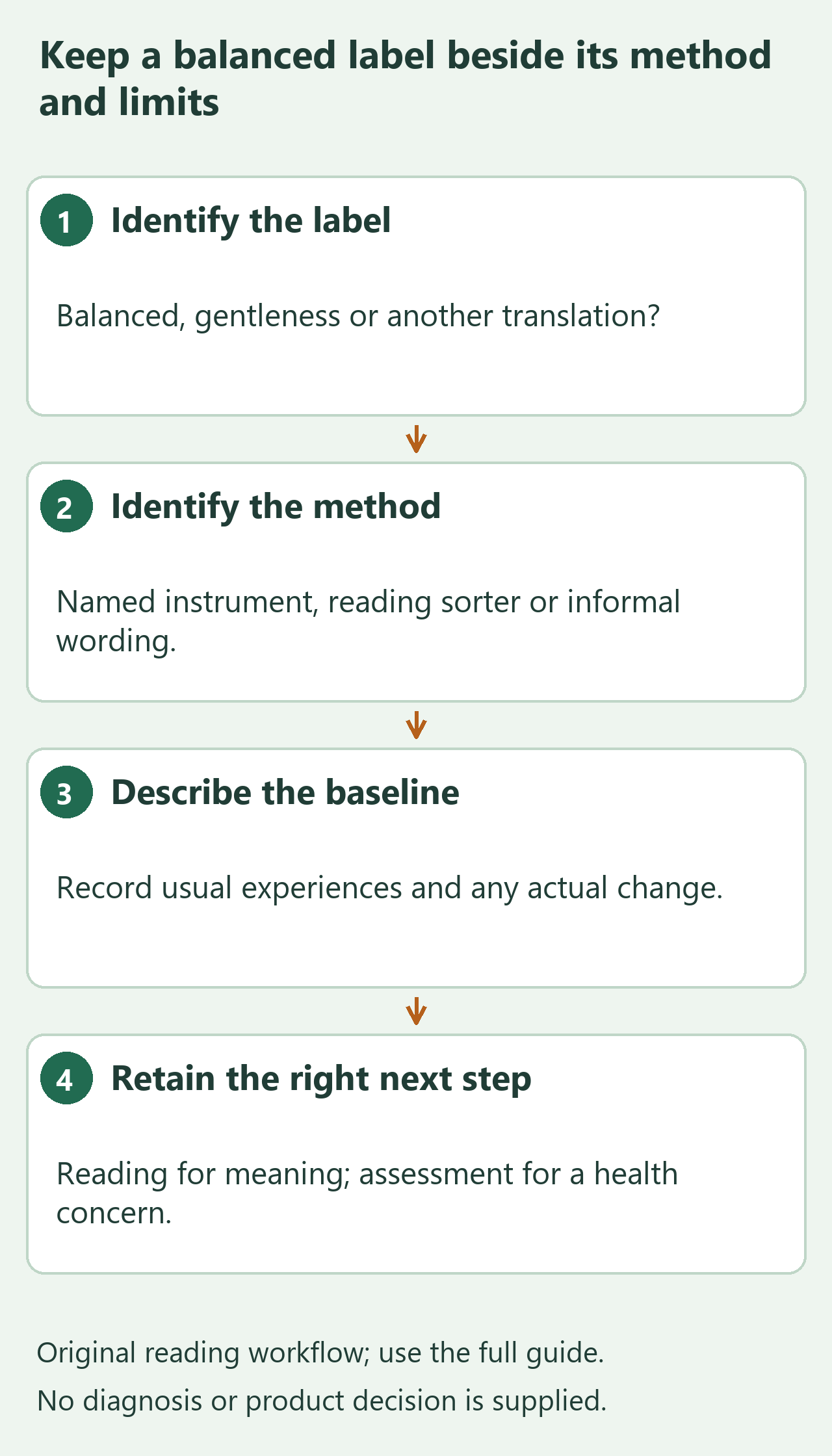
Keep a balanced label beside its method and limits
Examples to work through
These fictional examples practice reading and keeping information accurate.
Balanced after an informal quiz
A fictional reader sees Balanced in a top-three list. They note which quiz produced it and open the meaning page. They do not describe the ranking as a validated category or use it to override other information.
A stable baseline and a new concern
Someone usually sleeps regularly but reports a recent change. The useful record includes the change and dates. A traditional balanced label does not decide its cause or whether assessment is needed.
Different English labels
One paper uses gentleness while a website uses balanced. Keep the instrument and source wording beside the result. A translation match alone does not establish that the tools used identical questions and rules.
A neutral-food shortcut
A chart calls a food neutral and recommends it universally to balanced readers. The traditional nature does not supply an allergy check or a medication review. Keep the exact food and personal question separate.
Baseline and category: two separate notes
Use these optional reminders for your own notes. The blank download contains all record fields. Keep a completed copy appropriately private; these controls do not submit entries.
Frequently asked questions
Does balanced constitution mean perfect health?
No. It is a traditional category in the framework discussed here. It does not rule out a health concern or replace appropriate assessment.
Are balanced and gentleness always interchangeable?
This site uses Balanced for the gentleness reading category. When comparing other sources, verify their questionnaire, translation and scoring rather than relying only on the English label.
Can I diagnose this category from steady sleep or appetite?
Those are ordinary observations. They do not by themselves establish a constitution category; a named questionnaire or assessment has its own method and limits.
Should balanced readers follow a special food list?
This page does not select a personal diet. A constitution label does not replace nutrition information, allergy checks or advice for an actual health circumstance.
Sources and what they support
- Wong et al. (2013): Validation of the Constitution in Chinese Medicine Questionnaire
The introduction, methods, discussion and conclusions were read for this repair: original 60-item scales, Hong Kong adaptation, overlap, score versus classification reproducibility and study limits. Other result tables and cited papers are not claimed independently reviewed here.
- Hong Kong CMRO: Health Preservation by Food in Chinese Medicine
Attributed traditional nature/flavor categories, named food forms and a four-part constitution appendix. Its traditional effect wording is not treated here as independently demonstrated clinical efficacy.
- NCCIH: Traditional Chinese Medicine—What You Need To Know
Dated April 2019 background on different practices, product risks, coordinated care and avoiding replacement or delay of conventional care; not a current review of every food or product.
These sources support the stated explanations and reading limits. They do not establish a clinical review of this website, validate its fourteen-question sorter, or assess an individual product, symptom or treatment.